Unity Renewables
The NanoGrid Mobile Blueprint

Build your own 10 kWh portable power system.

Step-by-step plans for a 48 V LiFePO4, 4,500 W, 120 V system you can roll onto a food truck, a job site, or an event. Written by Unity Renewables, the Rochester, NY company that builds, delivers, and services the PowerBox 10K.

$147 one-time

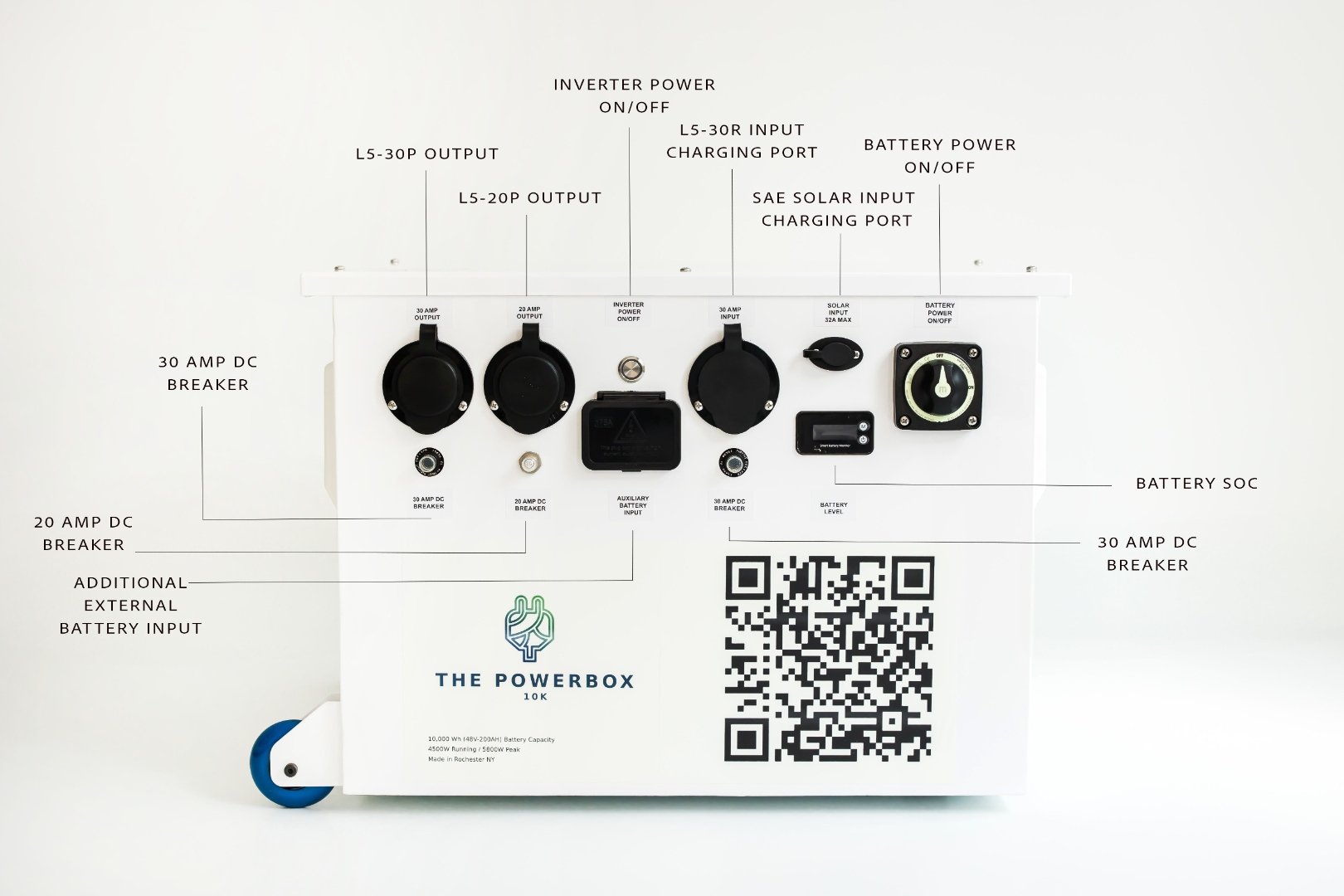
PowerBox 10K front panel with labeled L5-30R and L5-20R outputs, L5-30P charging inlet, SAE solar input, auxiliary battery input, AC breakers, battery level display, and battery switch
The PowerBox 10K front panel. The Blueprint shows how to build and wire every port.
What you'll build

Based on the PowerBox 10K.

The Blueprint walks through the enclosed, rolling build behind the PowerBox 10K: the parts, the wiring, the torque values, and the inverter settings we use on units in the field.

Battery bank
10.24 kWhTwo 51.2 V, 100 Ah LiFePO4 batteries in parallel
Inverter/charger
4,500 WPure sine wave, 120 V, 6,750 W surge for 5 seconds
AC outlets
30 A + 20 AL5-30R and L5-20R locking receptacles, each on its own breaker
Charging
AC + solarShore power, a generator, or a household outlet, plus solar panels
Weight
About 210 lbThe PowerBox 10K, on locking casters with two handles
What's inside

Twelve chapters, from the first safety rule to the last setting.

Every step is written for someone building a system like this for the first time, with the ratings each part needs so you can substitute when a part is out of stock.

  1. 01Safety firstThe rules for a 48 V lithium bank and 120 V AC, before you touch a part.
  2. 02How the system worksThe DC side, the AC side, controls, and grounding, in plain language.
  3. 03Choosing the core partsBatteries, inverter/charger, and solar controller, and what each must be rated for.
  4. 04Parts listEvery part with its required rating, a recommended pick, and a budget pick where one exists.
  5. 05Enclosure and layoutWhere everything goes, airflow, service access, and casters rated for the weight.
  6. 06Tools and torqueThe tools you need and a torque value for every connection.
  7. 07Build stepsDC wiring, AC wiring, controls, grounding, labels, and the 30 A cord, step by step.
  8. 08GroundingStandalone use versus prewired trucks, plus GFCI protection for job sites.
  9. 09Commissioning and settingsFirst power-up, every inverter and solar setting, battery balancing, and solar sizing.
  10. 10The other four buildsVehicle install, open rack, wall-mount backup, and half-size 5 kWh. In the Complete Builder Kit.
  11. 11Runtime, use, and careRuntime estimates, cold weather, external batteries, and upkeep.
  12. 12TroubleshootingWhat to check, in order, when something does not work.
Sample page

Diagrams you can build from.

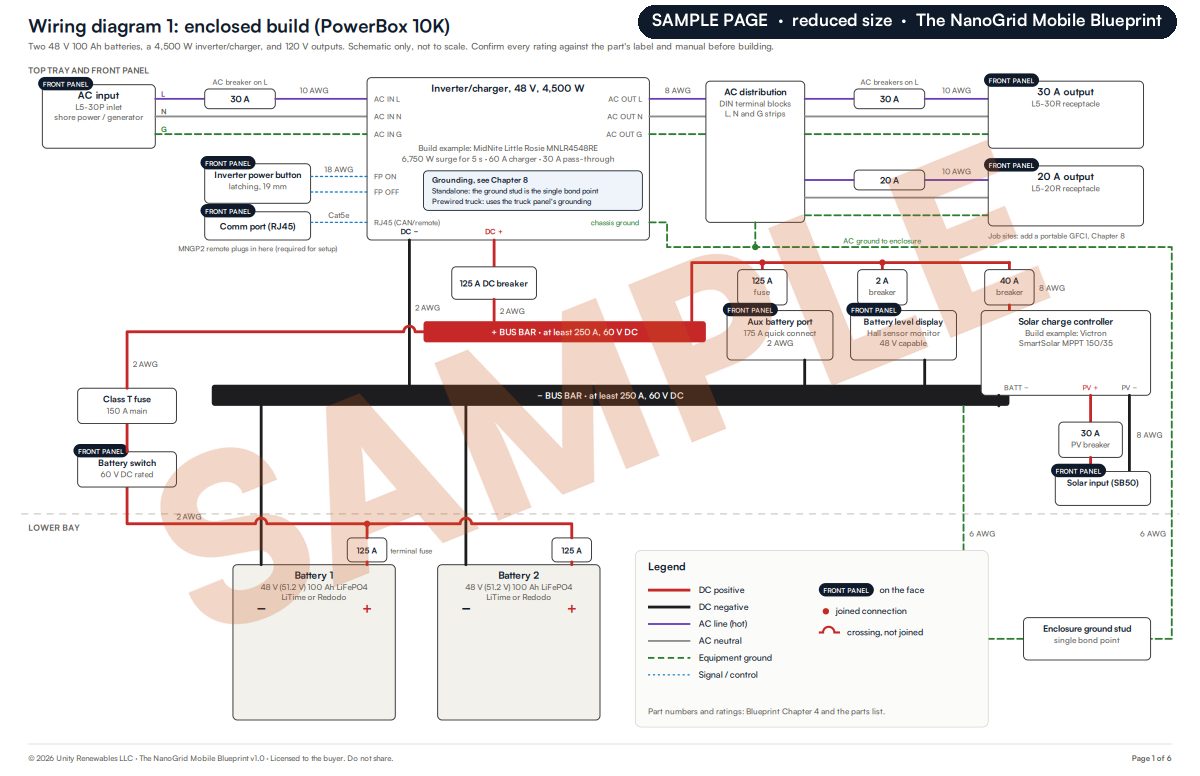
Each build has its own diagram page, drawn from the way we wire PowerBox units in our shop: every cable size, fuse, breaker, and bus bar connection, with the grounding shown for standalone use and for prewired trucks.

  • Wiring and layout pages for the enclosed build
  • A parts list with links, a recommended pick, and a budget pick
  • Inverter and solar charge settings, with the reason for each one
  • Step-by-step photos from a new PowerBox build
Sample page from the NanoGrid Mobile Blueprint: the wiring diagram for the enclosed 10 kWh build, marked as a sample
Wiring diagram 1, the enclosed build. Shown at reduced size.
Two editions

Pick the build you need.

Enclosed build

The NanoGrid Mobile Blueprint

For one portable, rolling system like the PowerBox 10K.

$147 one-time
  • Chapters 1 to 9, 11, and 12 as a PDF
  • Wiring and layout diagrams for the enclosed build
  • The parts list, with links and budget picks
  • Torque table, inverter and solar settings, and troubleshooting
  • Step-by-step build photos
Opening soon

Opening soon. We are photographing and filming a new PowerBox build for the Blueprint now. Follow us on Instagram or Facebook to see the go-live date.

Is it a fit

Built for hands-on people.

A good fit if you

  • Are comfortable with hand tools, a multimeter, and a torque wrench
  • Want to understand, build, and service your own power system
  • Run a food truck, cart, event, or mobile service business and like to build your own equipment
  • Are a contractor, electrician, or installer who builds systems for customers

Not the right fit if you

  • Would rather have it done for you. The PowerBox 10K is built, delivered, and set up for you.
  • Want to connect a system to a building without hiring a licensed electrician
  • Need a UL 9540-listed home battery system for a permanent install
From the shop that builds them

Written from units working in the field.

About 15 PowerBox units are working today on food trucks and mobile businesses from Nashville, TN to Westborough, MA. What we have learned building, delivering, and servicing them is in the Blueprint.

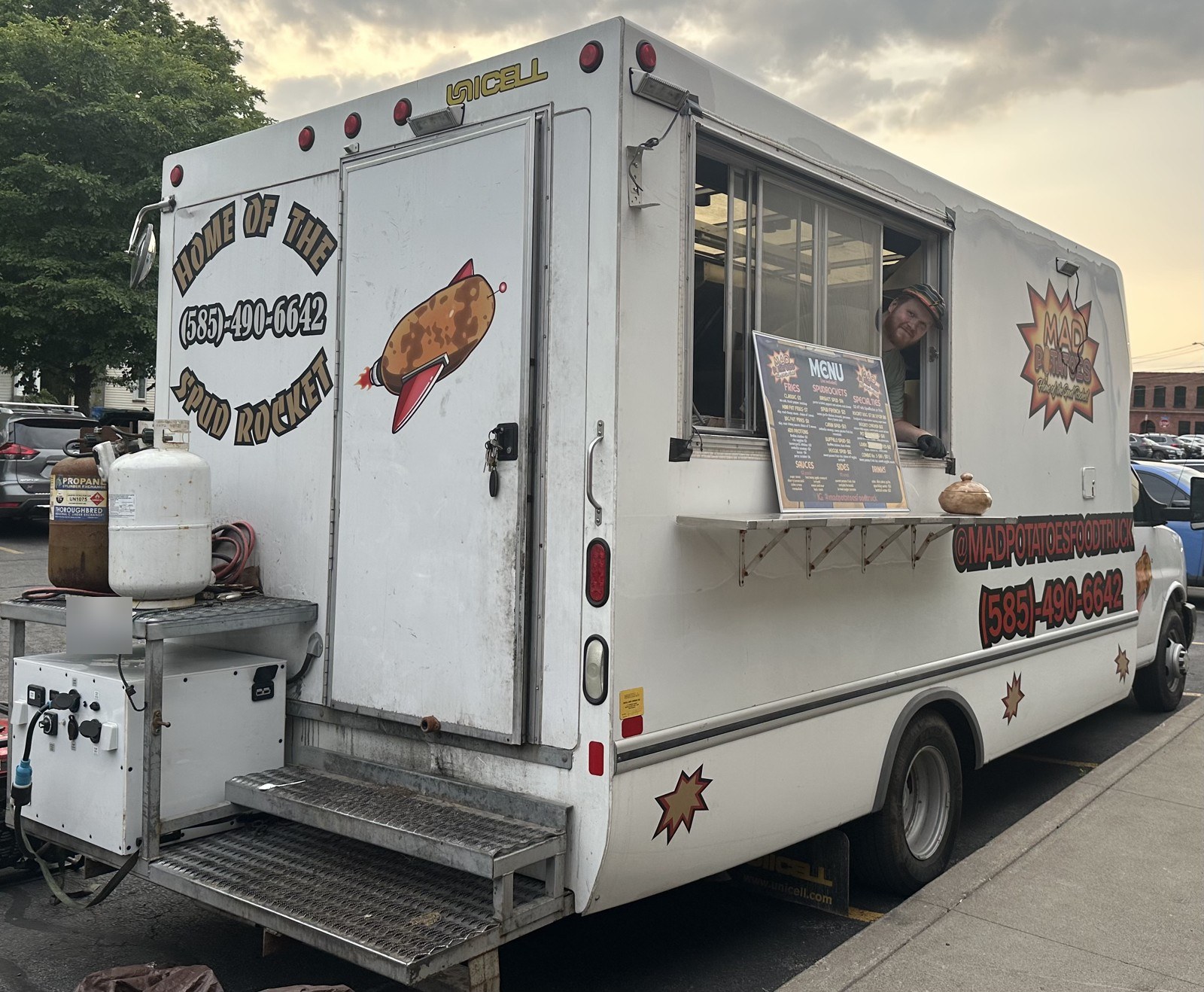
Mad Potatoes food truck from Nashville, Tennessee, showing its serving window, branded side panel, and rear-mounted PowerBox

This thing has been an absolute lifesaver for me and my business. Save yourself the money and trouble.

Mad PotatoesNashville, TN
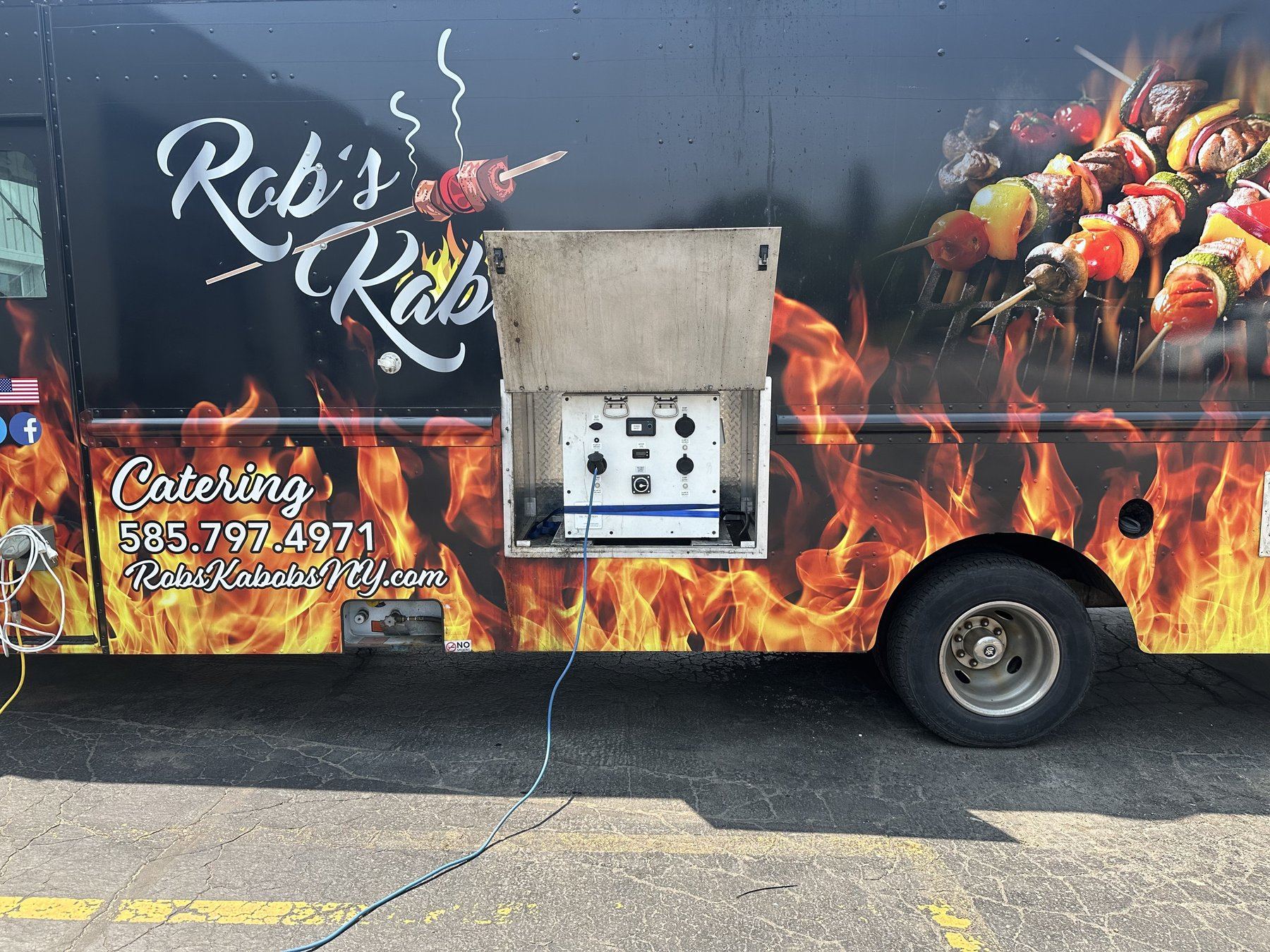
Rob's Kabobs food truck in Rochester, NY with a PowerBox 10K mounted in the exterior electrical compartment

Makes my life so much easier, not having to worry about a generator. Just pull up to an event and everything is still running. Been a lifesaver to me and my business.

Rob's KabobsRochester, NY

Read this before you buy

  • This is a 48 V lithium battery system with 120 V AC outputs. Built or used carelessly, it can cause fire, electric shock, serious injury, or death.
  • Chapter 1 sets out the safety rules before the first wiring step. Read the whole Blueprint, and the manual for every core part, before you buy anything.
  • Use listed components, and use each one only within its printed ratings.
  • Any connection to a building's wiring must be made by a licensed electrician, with a permit, through a listed transfer switch or interlock.
  • A permanent home battery install may need a UL 9540-listed system. Check with your building department first.

The Blueprint is educational. You are responsible for following the codes that apply where you live and use the system, and for hiring a licensed electrician where required. Unity Renewables does not inspect or certify systems built from the Blueprint.

Questions

Before you build.

A step-by-step guide to building a 10 kWh, 48 V LiFePO4, 4,500 W, 120 V portable power system, with a parts list, wiring diagrams, torque values, and inverter and solar settings. You download it as a PDF after checkout. Each copy is licensed to the person who buys it.

Not for the portable builds, if you are comfortable with hand tools, a multimeter, and a torque wrench, and you follow every step. Any connection to a building's wiring must be made by a licensed electrician, with a permit, through a listed transfer switch or interlock.

The enclosed build uses a MidNite Solar Little Rosie MNLR4548RE inverter/charger, two 51.2 V, 100 Ah LiFePO4 batteries in parallel, and a Victron SmartSolar MPPT 150/35 charge controller. The parts list gives the rating each part needs, so you can substitute.

The parts list shows the current price of each part, with a budget pick where one exists. The two batteries and the inverter/charger are the largest costs. Prices change, so buyers get a live parts list with current links.

From shore power, a generator, or a household outlet through the inverter's built-in charger, and from solar panels through the charge controller. Chapter 9 gives the settings for each source.

Yes. The vehicle install in the Complete Builder Kit uses MidNite's mobile inverter/charger, the MNLR3648M, with steps for vehicle wiring, mounting, and grounding.

Both editions go on sale once the new build is photographed and filmed. Follow us on Instagram or Facebook to see the go-live date.

All sales are final. If a file will not open or is missing, email powerbox@unityrenewables.com and we will send a working copy. You can ask us for a written copy of this policy at any time.

Not today. If we add affiliate or dealer links later, we will label them clearly.

Yes. The PowerBox 10K is hand-built in Rochester, NY and load-tested before it ships, with delivery and setup within a 6-hour drive of Rochester, NY.

Done for you

Rather have it built for you?

The PowerBox 10K is hand-built in Rochester, NY, load-tested before it ships, and delivered and set up within a 6-hour drive of Rochester, NY.

See the PowerBox 10K Get a Quote